ResearchT&C Applied
Privacy Policies, Rewritten for an 8th Grader
T&C Applied rewrites privacy policies into plain English, flags unfair clauses and answers follow-up questions.
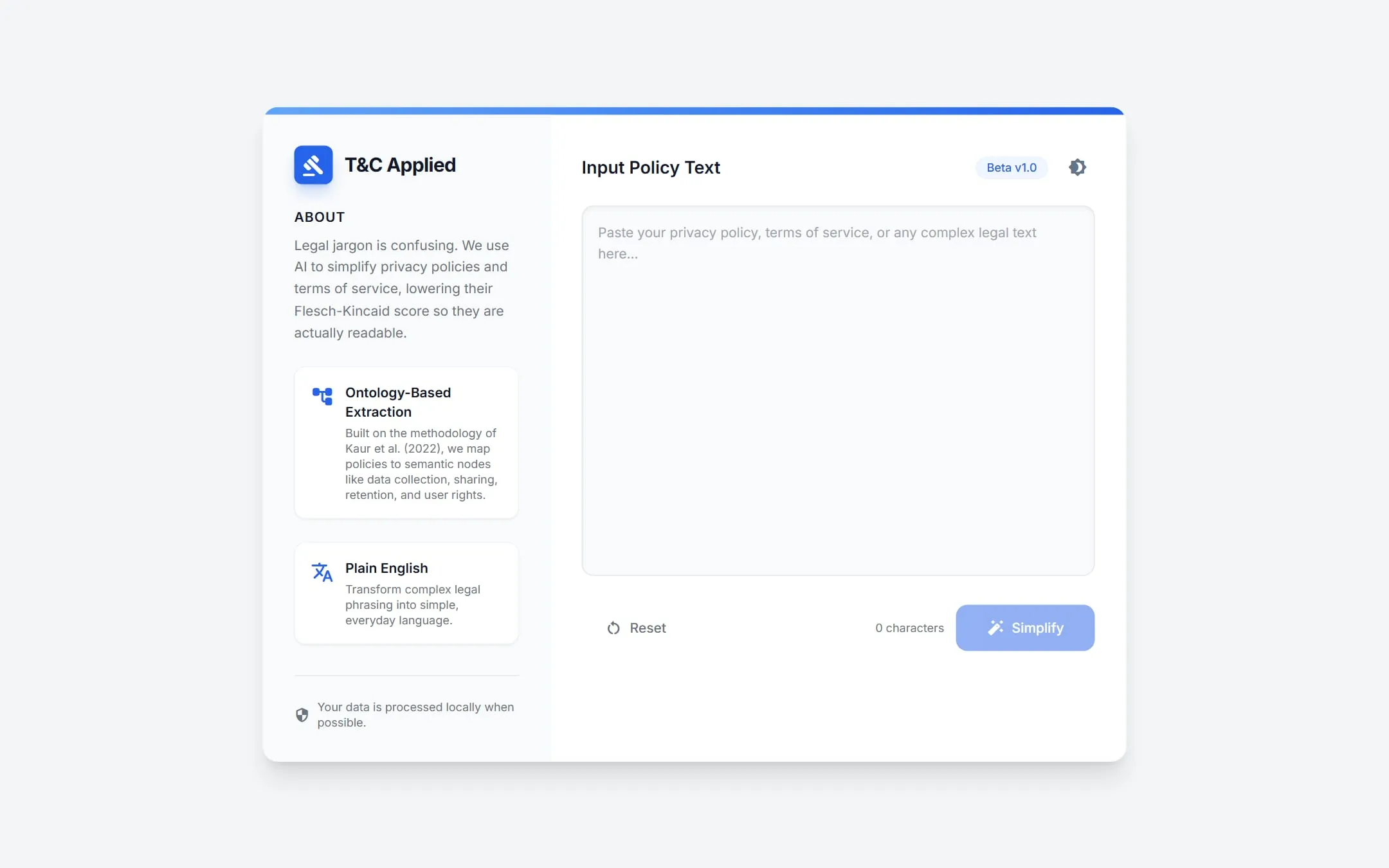
Rochester, N.Y. Nobody reads privacy policies, and I wanted to know if that was on us or on them. So before building anything, I measured it. I took the privacy policies and homepage marketing text from 10 organizations, including Apple, Nike, OpenAI, TikTok and RIT, and scored both with Flesch-Kincaid.
The results were clear. Marketing text averaged grade 11.7. Privacy policies averaged grade 15.4. The same organizations write 3.7 grade levels harder when they explain what happens to your data than when they want your attention. I wrote it up as a paper, The Transparency Gap.
The final grade is shown next to the result, so you can see the number instead of trusting the model's word.
T&C Applied is the tool that came out of it. You paste a policy into the React frontend. An Express backend sends it to Llama 3.3 70B on Groq, which maps the clauses into five categories: data collection, third-party sharing, data retention, user rights and security. That follows the ontology-based extraction method from Kaur et al. (2022).
The readability loop is what keeps the model honest. The model's rewrite gets scored with a real Flesch-Kincaid library. If it's above grade 8, the score goes back to the model with a request to simplify further, up to 2 retries. The final grade is shown next to the result, so you can see the number instead of trusting the model's word.
It also flags biased clauses, like forced arbitration, selling data without consent and the right to change the terms whenever they want, each rated high, medium or low. A chat page lets you ask follow-up questions about the policy you just analyzed.
An early version would happily simplify random text that wasn't a policy at all and invent a result. I fixed that. Rate limits from Groq's free tier come back as a clear retry message with the wait time instead of a broken page.
I built it in two days in February 2026. It's small, about 1.2k lines. The paper came first, and the app is my answer to it.
How it works
T&C Applied, start to finish, in 6 steps.
- Step 1:
Paste
User pastes a privacy policy
- Step 2:
Extract
Llama 3.3 70B sorts clauses into 5 categories
- Step 3:
Rewrite
Plain-English version of each section
- Step 4:
Score
Flesch-Kincaid check, back to the model if above grade 8
- Step 5:
Flag
Biased clauses rated high, medium or low
- Step 6:
Chat
Follow-up questions about the policy
Graphic: The Sahil Bachu